
Article 8, the engine of national schemes
Article 8 of Directive (EU) 2023/1791 of 13 September 2023 on energy efficiency is the provision that gives rise to an energy savings scheme in every Member State. French energy savings certificates, Italian Certificati Bianchi and Spanish certificates all answer to this same rule.
Our guide to energy savings obligations in Europe sets out the general framework and compares the schemes. This guide goes into the text of Article 8 itself. It explains how the required volume is calculated, what counts and what no longer counts, and what States must notify to the European Commission.
These technical rules determine, country by country, which works can be valued and under what conditions. They are therefore directly relevant to industrial companies, landlords, installers and obligated parties.
A volume of cumulative savings, not an isolated annual rate
Article 8(1) requires "cumulative end-use energy savings". Final energy is the energy received by the consumer: electricity at the meter, gas at the boiler, fuel at the pump. The text sets this volume as new annual savings, expressed as a percentage of final energy consumption.
The steps of the 2021-2030 period
The reference consumption is the average of the most recent three-year period prior to 1 January 2019. The steps are as follows.
| Period | New annual savings | Regime for Cyprus and Malta |
|---|---|---|
| 2021 to 2023 | 0.8% of final energy consumption | 0.24% |
| 2024 and 2025 | 1.3% of final energy consumption | 0.45% |
| 2026 and 2027 | 1.5% of final energy consumption | 0.45% |
| 2028 to 2030 | 1.9% of final energy consumption | 0.45% |
According to the European Commission, the revised directive more than doubles the annual energy savings obligation by 2028. After 2030, Article 8 provides that States continue at the 1.9% rate over ten-year periods.
Freedom to spread savings, within limits
Each Member State chooses the pace of its savings within a period. The only condition set by Article 8 is that the required cumulative total is reached before the end of each obligation period. This flexibility explains why the annual targets shown by national schemes do not always follow the European steps to the letter.
Calculation options reserved for 2021-2023
Paragraphs 6 to 9 of Article 8 open calculation options: excluding all or part of transport energy, removing certain industrial activities covered by the carbon market, or counting certain earlier actions. These options apply only to the 2021-2023 period. Taken together, they cannot reduce the calculated savings volume by more than 35%.
For the steps starting in 2024, Article 8 does not provide for these calculation options.
What counts, and what no longer counts
Article 8(2) refers to Annex V of the Directive for the calculation of savings. This annex sets common rules for all States, whatever national instrument is chosen.
Four ways to measure a saving
Annex V allows several calculation methods. They are presented below.
| Method | Principle under Annex V |
|---|---|
| Deemed savings ("ex ante") | Reference to independently monitored results in similar installations |
| Metered savings ("ex post") | Measurement of the actual reduction in use, adjusted for occupancy, production or climate |
| Scaled savings | Engineering estimates, where measurement is difficult or disproportionately costly |
| Survey-based savings | Reserved for behavioural changes, never for physical measures |
For the share reserved for energy poverty, Annex V also allows engineering estimates based on standardised occupancy and thermal comfort conditions.
Fossil fuels leave the calculation
The 2023 recast changes the nature of eligible savings. Under Annex V, savings from policy measures newly implemented from 1 January 2024 regarding the direct combustion of fossil fuels are not counted. Where a measure combines several technologies, the share linked to fossil combustion is removed.
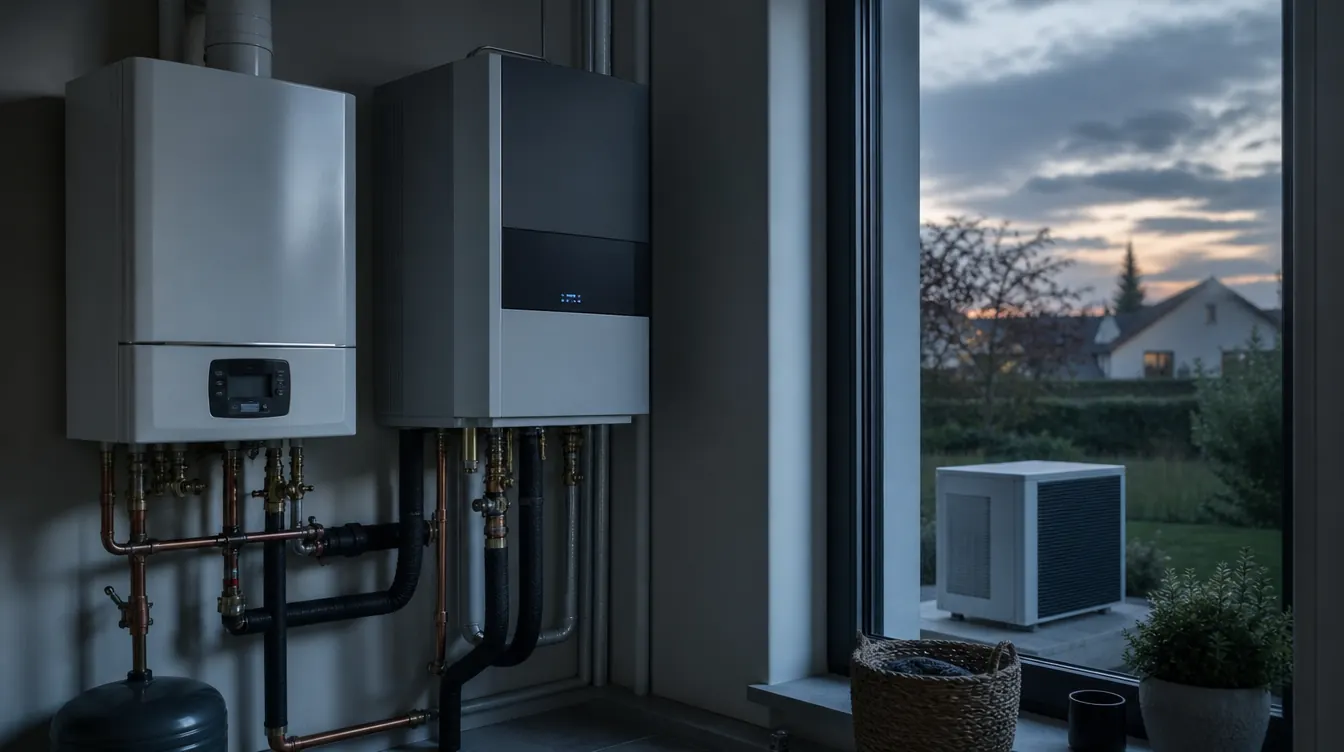
Annex V also excludes, from 1 January 2026, measures that subsidise the direct combustion of fossil fuels in residential buildings. A more efficient gas boiler therefore no longer contributes, as a general rule, to the European obligation.
A derogation exists until 31 December 2030 for energy-intensive industrial companies. It requires, among other things, an energy audit under Article 11(2) and an implementation plan for measures with a payback period of five years or less.
Additionality and the ban on double counting
Annex V considers that savings required by Union law would have happened anyway. They are therefore not reported under Article 8. Renovation of existing buildings is an exception, subject to the materiality criterion.
Finally, Article 8(14) requires States to demonstrate that savings are not counted twice where several measures overlap. The national balance therefore cannot count the same saving twice.
The share reserved for energy poverty
Article 8(3) asks States to implement their measures as a priority, but not exclusively, for people affected by energy poverty. Vulnerable customers, low-income households and people living in social housing are also covered.
How the share is set
The Directive requires a minimum share of the cumulative volume to be achieved among these groups. This share is at least equal to the proportion of households in energy poverty assessed in the national energy and climate plan, the NECP. The NECP is the ten-year plan each State draws up under Regulation (EU) 2018/1999 on the governance of the energy union.
To assess this proportion, States take into account four Eurostat indicators:
- inability to keep the home adequately warm;
- arrears on utility bills;
- the share of the population living in a dwelling affected by damp or leaks;
- the at-risk-of-poverty rate, at the threshold of 60% of median equivalised income after social transfers.
If a State has not notified its proportion, the minimum share is the arithmetic average of these indicators for 2019.
A duty to do no harm
Article 8 also requires that measures have no adverse effect on these groups. Commission Recommendation (EU) 2024/1590 cites several risks, including an energy price increase not offset by savings, or a renovation that neglects ventilation.
In an obligation scheme, Article 9(5) allows States to impose this share directly on obligated parties. Obligated parties then report each year the savings achieved among these households.
Obligation, alternative measures or both
Article 8(2) leaves each State to choose its instrument. It may set up an obligation scheme under Article 9, adopt alternative policy measures under Article 10, or combine the two.
| Comparison point | Obligation scheme (Article 9) | Alternative measures (Article 10) |
|---|---|---|
| Who carries the effort | Obligated parties: network operators, distributors, energy or fuel retailers | The State, through participating or entrusted parties |
| Instruments | Savings achieved or financed, possible contribution to a national fund | Grants, taxation, voluntary agreements, regulation |
| Verification | Independent verification of a representative share of measures | Same requirement for every non-tax measure |
| Third-party savings | Countable if the State allows it, after certification | Depends on the national scheme |
| Transparency | Annual publication of savings per obligated party | Progress reports sent to the Commission |
Two rules of Article 9 matter particularly for project developers. Certified savings achieved by energy service providers or other third parties may be counted, if the State allows it. A saving may also be attributed to one of the four previous years or the three following years, without going beyond the end of the obligation period.
For a tax measure, Article 10 asks the State to demonstrate the effectiveness of the price signal, for example through the tax rate and its visibility over time.
Notifications, verification and catch-up
What the State must report
Article 8(11) requires each State to notify the Commission of the required savings volume, the energy poverty share, the description of measures and their calculation methods. This notification goes through NECP updates, using a reporting template provided by the Commission. National progress reports complete this monitoring.
Where the Commission considers a State's measures insufficient to achieve the required volume, Article 8(12) allows it to issue recommendations to that State.
Catch-up from one period to the next
Article 8(13) does not leave a shortfall without consequence. A State that does not achieve its cumulative savings by the end of an obligation period must achieve the missing savings on top of the volume required for the next period. Conversely, a surplus may be carried over to the next period up to a limit of 10%.
Key deadlines
| Deadline | Subject |
|---|---|
| 11 October 2025 | Transposition deadline for Articles 5 to 11 of the Directive |
| 1 January 2026 | Exclusion of measures subsidising fossil combustion in dwellings |
| 2026 and 2027 | Step of 1.5% new annual savings |
| 2028 to 2030 | Step of 1.9% new annual savings |
| 31 December 2030 | End of the obligation period and of the industrial derogation |
The European Commission states that it is preparing a post-2030 energy efficiency framework, scheduled for publication in the last quarter of 2026. The related public consultation ran from 20 March to 12 June 2026.
What this means for you
For an industrial company
The exclusion of fossil technologies narrows the range of eligible operations. Electrification, heat recovery or control projects become more attractive. The industrial derogation exists, but it relies on an energy audit and a documented implementation plan.
For a landlord or project owner
The share reserved for energy poverty directs part of the funding towards social housing and low-income households. Each national scheme must build this requirement into its design.
For an installer or energy service company
Recognition of third-party savings depends on each State's choice and its certification procedure. Before making an offer in another country, you need to know the instrument chosen and the party that buys the saving.
For an obligated party or delegated entity
The catch-up rule and the rise of the rate to 1.9% in 2028 point to sustained volumes until 2030. Independent verification and the ban on double counting increase the value of robust, traceable files.
Our recommendations
IHD reads each national scheme from the official texts, starting with how the State has transposed Articles 8, 9 and 10. Our role as an independent engineering consultancy is to identify the instrument applicable to a project, the party that will value it and the documents that will secure the file through to valuation.
In France, Article 8 takes the form of the scheme described in our guide to energy savings certificates. In Italy, our analysis of the Certificati Bianchi shows another design of the same mechanism. Our international markets page presents our support outside France. For a specific project, contact us.