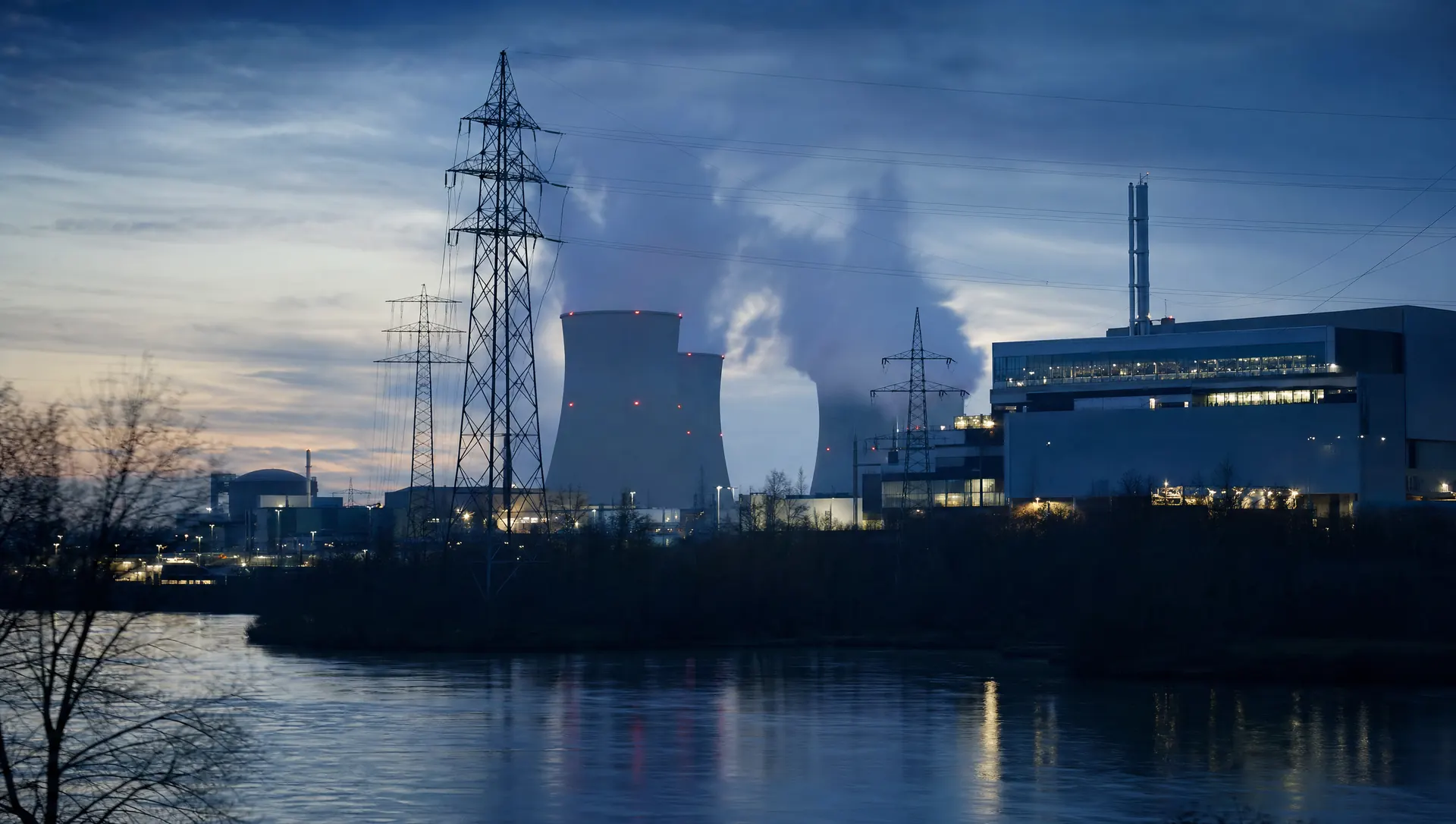
Why buying energy has become a board-level decision
Since 2011, part of the electricity price paid by French businesses rested on an administered price. That era is over. Since 1 January 2026, the supply price has followed the wholesale markets, and every contract signed commits the business to a price level and a term.
Buying electricity and gas is therefore no longer a routine accounts-payable task. It is a trade-off between stability and flexibility, which weighs on a manufacturer's margin as much as on a local authority's budget. This guide sets out the rules currently in force and the points to examine before signing.
What a business pays for on its electricity bill
A business electricity bill adds up three main components.
The first is supply: the energy itself, whose price depends on the supplier and the contract. It is the only part genuinely open to competition.
The second is delivery. The tariff for the use of public electricity networks (TURPE) pays for transmission, provided by RTE, and distribution, provided by Enedis. It is set by the Energy Regulatory Commission (CRE) and applies whichever supplier is chosen.
The third covers taxes and levies, set by law.
The CRE decision on TURPE 7 covers the 2025-2028 period. It raised the distribution tariff by 7.7% on 1 February 2025. It also provides for the gradual roll-out, from autumn 2025, of off-peak hours in the afternoon in summer, to take advantage of the abundant solar output at those times. For a site whose activity can be shifted, this placing of off-peak hours can matter when choosing a tariff option.
Regulated tariff or market offer: who has the choice?
The electricity and natural gas market has been open to competition for business customers since July 2004. Two families of contracts coexist.
The regulated electricity sales tariff (TRVE) is a price set by the public authorities. Only EDF offers it, or a local incumbent supplier on 5% of the territory. A market offer is a contract whose price is set by the supplier; any supplier can offer one.
Access to the TRVE was widened by Law No. 2024-330 of 11 April 2024. According to the national energy ombudsman, all very small businesses (TPE) have had access to it since 1 February 2025, whatever their subscribed power. Previously, a contract of 36 kVA or less was required.
| Business profile | Electricity | Natural gas |
|---|---|---|
| Fewer than 10 employees and no more than 2 million euros in turnover, receipts or balance sheet | Regulated tariff or market offer, as preferred | Market offer only |
| Above either of these thresholds | Market offer only | Market offer only |
According to the ombudsman, this extension raises the number of eligible very small businesses from 2.7 million to 3.7 million, and the number of eligible municipalities from 15 000 to 25 000.
The end of ARENH changes the price benchmark
Regulated access to historical nuclear electricity (ARENH) was created by the NOME Act of 7 December 2010. From 1 July 2011, it allowed consumers, whatever their supplier, to access part of the output of EDF's historical nuclear power stations at a regulated price. That price had been set at 42 €/MWh since 2012.
The scheme ended on 31 December 2025. In its press release of 30 April 2025, the CRE draws the consequence: suppliers now source their power on the market or from their own generation assets. Wholesale prices become the benchmark for the sourcing share of bills.
The CRE has therefore stepped up its monitoring of the wholesale market. In the first quarter of 2025, it observed sufficient liquidity there to hedge at least up to year n+3. Liquidity remained limited at the n+4 horizon and low at n+5. This finding has a direct bearing on contract length: beyond three or four years, offers are fewer and prices less transparent.
Fixed or indexed price: two purchasing approaches
A market offer is built around two main pricing approaches.
A fixed price is an energy price locked in at signature for the whole term of the contract. It protects the budget against a market rise, but it also freezes the price if markets fall. It suits a business that must hold a margin or a budget approved in advance.
An indexed price is a price that tracks a market benchmark according to a formula set in the contract. It lets the business benefit from a fall, but it exposes it to every rise. It suits an organisation able to absorb variations, or one that buys in tranches.
Between the two, many offers combine a fixed share and an indexed share. The right balance depends on the weight of energy in costs, visibility over activity and management's appetite for risk.
The timing of signature matters too. In its April 2025 press release, the CRE noted that electricity forward prices had mostly ranged between 60 and 70 €/MWh since the end of the 2022-2023 crisis. This level is a dated observation, not a forecast: it simply illustrates the value of tracking the markets before committing.
The universal nuclear payment: a safety net, not a price
The 2025 Finance Act created the universal nuclear payment (VNU), applicable from 2026. It is not a new tariff. It is a protection mechanism that only comes into play when wholesale prices rise sharply.
According to the CRE, a tax applies to the revenues EDF earns from its nuclear output, only in years when those revenues exceed thresholds set by law. It takes 50% of revenues above the first threshold and 90% above the second. The proceeds are redistributed in full to consumers.
For a buyer, the consequence is simple: the VNU does not replace a purchasing strategy. It cushions an extreme price shock, but it guarantees no level of bill.
Natural gas: market offers only
The regulated sales tariff for natural gas has been abolished. A business, whatever its size, therefore buys its gas through a market offer, at the price set by contract with the supplier of its choice.
The same trade-offs apply as for electricity: fixed or indexed price, length of commitment, exit terms.
What this means for you
For a very small business, a co-ownership or a small municipality
You can choose between the regulated tariff and a market offer. The regulated tariff provides a public benchmark; a market offer can provide a fixed price over several years. Before any change, the ombudsman recommends checking the early termination fees in your current contract, which are payable even for a return to the regulated tariff.
For an SME, a mid-sized company or an industrial site
You buy through market offers, with no administered price underneath. Purchasing timing, contract length and the fixed-price share become risk management decisions. The market depth observed by the CRE calls for caution on commitments of more than four years.
For a property manager or a local authority
Grouping sites, aligning contract end dates and adjusting subscribed power weigh as much as the unit price. The new summer off-peak hours may also change the appeal of certain options.
What we recommend
Good energy purchasing starts with a sound knowledge of your consumption: hourly profile, seasonality, power actually drawn. An offer compared without this basis remains a gamble.
IHD supports businesses with independent energy brokerage, drawing on the legislation and on regulators' publications. Our role is to give you a clear reading of offers, commitments and risks, right through to signature. Discover our energy brokerage service. To act on the volumes you consume as well, our energy audit identifies savings potential. For a tender or a contract renewal, contact us.